28.08.2026
Six New Briefs Explore the Workforce Challenges of the Mobility Transition
The mobility transition is reshaping not only vehicles and production systems, but also the capabilities, jobs and learning systems needed to support them. Yet this transformation is not following a single, predictable path. Companies are managing multiple powertrain technologies, accelerating digitalisation, changing supply chains and emerging skills needs, while workers, education and training systems, and regions must adapt alongside them.
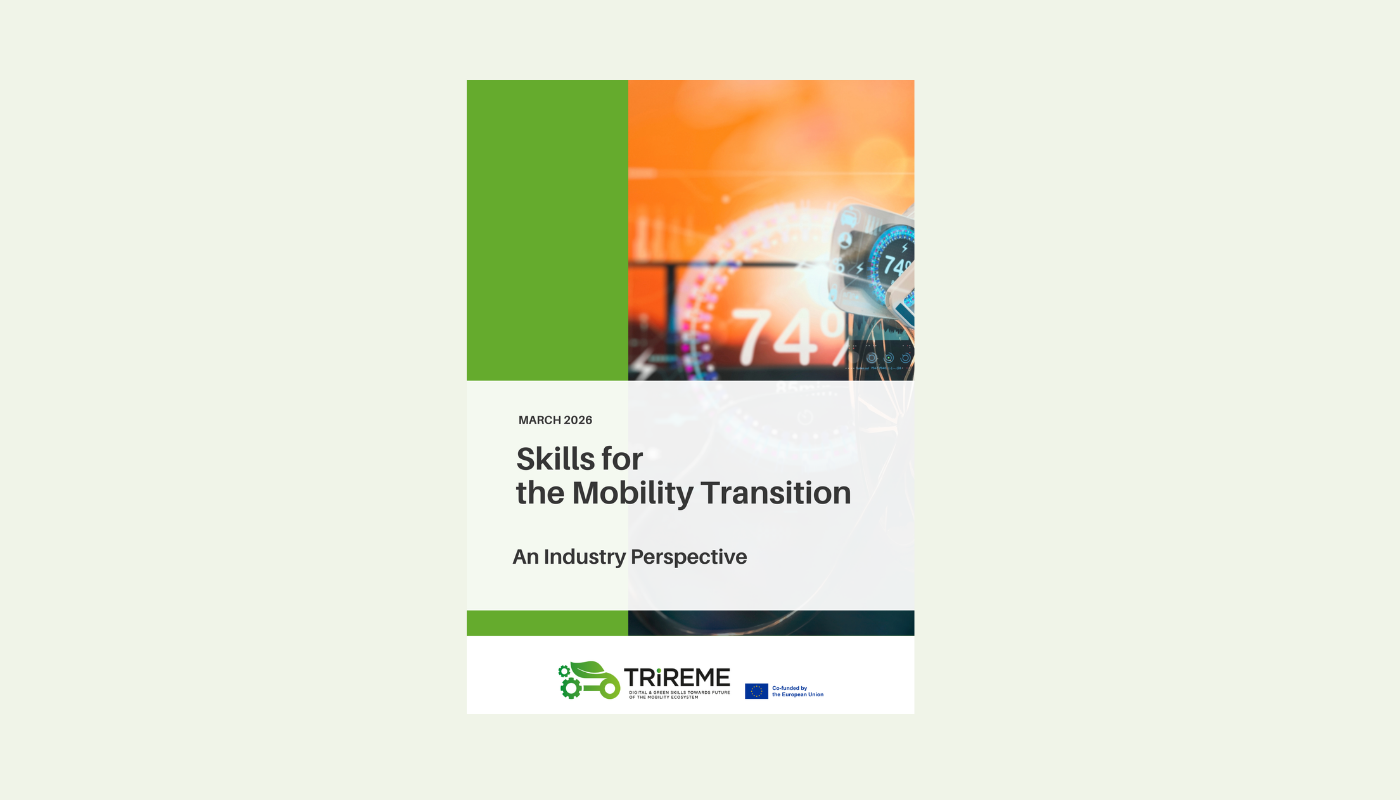
To explore these challenges from an industry perspective, TRIREME has released a collection of six briefs drawn from its Sectoral Skills Intelligence report, Skills for the Mobility Transition: An Industry Perspective. The report is based on structured interviews with 60 industry stakeholders from across the automotive and mobility value chain, conducted in 2025.
The six briefs examine different dimensions of workforce transformation, from building capabilities while the direction of the transition remains uncertain and adapting to changing industrial geographies, to reskilling within operating production systems and strengthening the connection between education and industry.
The mobility transition is proving less linear than the expectation of a straightforward shift from combustion engines to electric vehicles. Companies and their workforces must prepare for ICE, hybrid, plug-in hybrid and BEV production to coexist for longer than expected, while software-defined vehicle development continues to accelerate. Capability Before Certainty examines why this uncertainty makes capability-building more urgent. Rather than waiting for markets and technologies to become predictable, companies need people who can connect different areas of expertise, such as high-voltage safety and production, cybersecurity and connected systems, battery management and energy systems, or AI and process redesign. The brief also points to practical approaches already being used to build these capabilities, including internal academies, mentoring, job rotation, modular learning, university partnerships, AI and digital twins.
Regionalisation is changing more than where vehicles and components are produced. It is also influencing where knowledge, control, decision-making and specialised talent are located across the mobility value chain. The Geography of Control explores how companies are balancing regional production with globally concentrated expertise, while also reconsidering outsourcing and workforce flexibility. As some advanced capabilities remain concentrated in particular locations, production sites still need sufficient digital competence to work with data tools, digital twins and OT/IT integration. The brief argues for stronger pre-competitive talent infrastructure, including shared academies, regional skills intelligence and structured links between companies and universities, to help regions localise production without also localising skills shortages.
For companies facing both emerging skills shortages and changing demand for traditional roles, upskilling is increasingly a question of redeployment: can workers acquire the capabilities needed for new roles while production continues? Learning Under Constraint examines the practical barriers to this process, including the time required to take workers away from production, limited access to suitable learning and the shortage of experts available to train colleagues. The brief highlights the value of learning approaches close to the workplace, including practical training, internal academies, modular courses, learning alongside experienced colleagues and partnerships with universities. It also points to an important challenge beyond training itself: new skills need to be recognised through certification, job grading and career progression if they are to become genuinely usable and transferable.
Automotive companies increasingly need software, AI and other digital specialists, but they cannot simply adopt the working model of the technology sector. The Physical Limits of Digital Work explores the tension between attracting digital talent through greater flexibility and the physical, operational and safety-critical realities of automotive production. Design, electronics and software work can be partly remote, while manufacturing remains dependent on equipment, shifts, production continuity and physical interaction. The brief also examines how AI, digital twins and robotics are being used in areas such as testing, visual inspection, predictive maintenance and simulation, while stressing that these technologies require defined processes, clean data and integrated systems. Cybersecurity creates an additional boundary, given the safety-critical nature of connected vehicles. The result is an emerging model in which workers increasingly combine digital tools with physical systems and safety responsibilities.
Workforce transition is shaped by a mismatch of speeds between companies and the wider systems around them. While firms may need to respond quickly to changing demand, vehicle programmes and emerging skills needs, labour regulations, funding mechanisms, curricula, employment services and regional policies can adapt more slowly. Moving at Different Speeds examines how this creates difficulties for redeployment and workforce planning. It calls attention to the need for more practical regional infrastructure connecting companies, education and training providers, employment services and public authorities. Labour-market intelligence, modular training, career guidance, dual education and more stable cooperation can help workers and companies respond to changing needs without relying solely on short-term projects or isolated initiatives.
As software-defined vehicles, electrification, AI, cybersecurity and automated production develop rapidly, the traditional sequence of education, recruitment and subsequent company training is becoming increasingly difficult to sustain. Learning at Industrial Speed examines how stronger connections between education and industry can help narrow the gap between what people learn and what companies need. The brief highlights the value of industry-academic programmes, company academies, internships, laboratories, bootcamps and other forms of practical engagement. It also stresses that emerging digital and technological capabilities do not replace traditional engineering knowledge: the future mobility workforce will still require expertise related to mechanical systems, materials and other established areas, alongside transversal capabilities such as analytical thinking, communication, responsibility, resilience and continuous learning.
Taken together, the six briefs provide complementary perspectives on a central challenge identified through the TRIREME Skills Intelligence work: how to develop and sustain workforce capabilities while the mobility transition itself remains in motion.
The findings show that preparing for the transition is not simply about identifying new technical skills. It also requires practical ways to reskill and redeploy workers, stronger connections between companies and education, regional systems that can respond to changing needs, and learning approaches capable of adapting as quickly as technology and industry evolve.
Explore the six briefs for a focused look at these different dimensions of workforce transformation, and consult the full Skills for the Mobility Transition: An Industry Perspective report for the complete findings from the 60 industry interviews.
SHARE THIS ARTICLE